
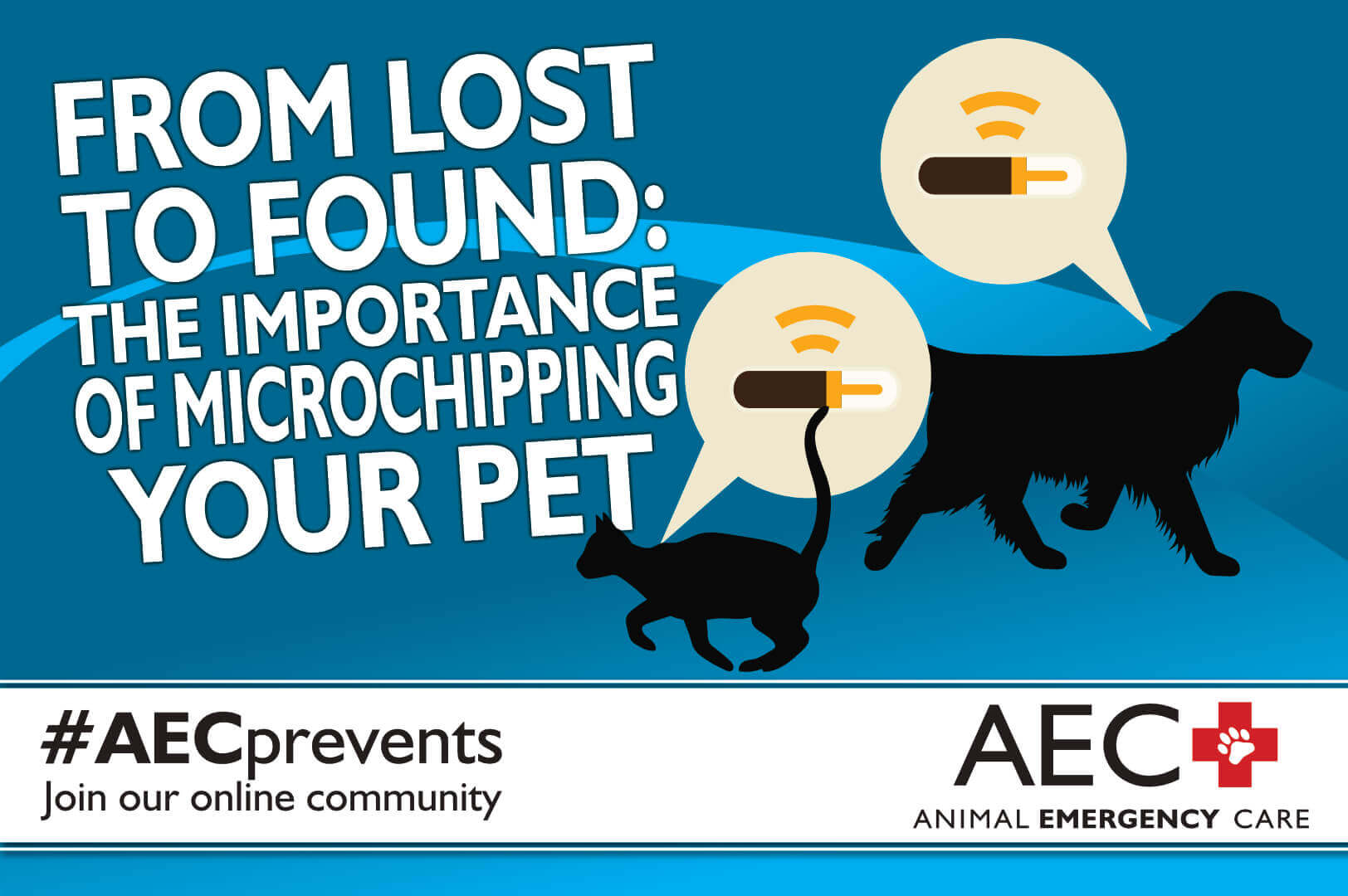
A beloved cat or dog going missing is one of a pet owner’s greatest fears. Our pets are family, and it can be devastating if we don’t know where they are. The American Humane Association estimates that approximately 1 out of 3 pets will go missing in their lifetime, and 80% will never be reunited with their families. Lack of identification is the main reason most wayward pets don’t make it home. The Animal Emergency Care team wants to ensure that your pets stay safe and do not become a statistic. Let’s talk about microchipping and how it can protect your pet if they ever become lost.
Post last updated on August 15, 2026.
What is a pet microchip?
A microchip is a small, cylindrical capsule about the size of a grain of wild rice. It uses passive radio-frequency identification (RFID) to store a unique number and letter combination, similar to a human’s social security number.
When the chip is implanted under the skin, it can be found and read with a handheld scanning device. The manufacturer of the microchip retains a registry of contact information volunteered by the person or organization who is responsible for each animal.
This device is not equipped with GPS and cannot be used to locate an animal, only to identify them once found. Your pet’s microchip does not store private information or specifics of your pet’s medical history, just the contact information you choose to provide.
Why does my pet need a microchip?
Even—perhaps especially—if your pet spends the majority of their life indoors, identification can save their life. Tags, IDs, or patches are useful, but if they get scraped off or removed, a microchip is the safest, most effective, and permanent means of identifying your pet.
Curious pets might sneak outside of the house or yard, lured by a squirrel or your neighbor’s barbecue. Anxious pets startled by loud noises may bolt and run until they are lost. Indoor pets are especially prone to straying, because they don’t have experience with animals, vehicles, and people in the neighborhood. If they get outside, their instinct is to find immediate safety. Hiding under a series of bushes or parked cars doesn’t always lead closer to home.
A lost dog is more than twice as likely to be reunited with you if they have been microchipped. Lost cats with microchips are more than 20 times as likely to be reunited with their owners as cats without! Microchips are even required by many countries for traveling pets, including re-entry into the United States.
How does a microchip get implanted into my pet?
Your veterinarian will insert the microchip under your pet’s skin between their shoulder blades. This is done with a sterile hypodermic needle just slightly larger than those used in vaccinations. The process takes less than one minute and causes minimal to no observable pain.
After the microchip is in place, your veterinarian will immediately scan your pet to ensure the chip is active. The identification number is then recorded in your pet’s medical record.
A microchip can be inserted at any age and during any routine veterinary visit.
What maintenance is required for my pet’s microchip?
The most important (and probably only) maintenance is keeping your contact information current! Your pet’s microchip will come with instructions on how to register your information, often this is a chip registration form and company website. It is vital that you register your pet’s chip. A 2009 Journal of the American Veterinary Association study found that 42% of microchips were not registered by pet owners. Tragically, an unregistered microchip may as well be a non-existent microchip. Without owner information associated with the unique microchip number, this is a dead end for pet identification and reuniting them with their family.
Though some microchip manufacturers offer additional paid services or subscriptions to pet owners, it should not cost money to keep your pet’s microchip information current.
If you are adopting a pet who already has a microchip from a shelter or rescue, they will often update the registration of that chip for you as part of the adoption process or tell you how to do so yourself. If you are not your pet’s first owner, you can use the tool in the next section to learn how to update their chip information to your phone number and name. Thank you for adopting!
Veterinarians have been implanting microchips for over 25 years, and there are very few complications. After the initial insertion of the microchip, nearly all maintenance of the chip is done without the animal’s direct involvement. Microchip replacement is not usually necessary and malfunction is quite rare. Microchips do not contain any moving parts or batteries, so they don’t need to be charged or serviced. Ask your veterinarian to check your pet’s microchip during their yearly exam. Alternatively, schedule an appointment on National Check the Chip Day to ensure the chip is functioning properly.
How to look up the microchip registry information for a pet
AAHA hosts an incredible online tool called Microchip Lookup. You can use it to check whether your pet’s microchip is currently registered, and if so, with which company. While the pet microchip lookup tool doesn’t have the capacity to update your chip information directly, it lets you know who can and how to contact them.
As long as their microchip has been registered, this same microchip lookup tool can be used to find the owner contact information for a stray animal you’ve found. Checking the chip can mean a safe trip home.
How to help a found animal that has a microchip
If you’ve found a lost pet, you have a few options to help discover where they belong:
- Your family veterinarian can scan a found pet for a microchip and contact their owner.
- Your local animal shelter will also check for microchips, hopefully avoiding a need for a lost pet to stay at the shelter at all.
- Our regional shelter, Whatcom Humane Society, will scan found animals during their operating hours. Visit their website for more resources on lost and found pets.
What if I find a dog during the weekend, late at night, or on a holiday?
If you find a dog or cat that needs help being reunited with its family outside of normal business hours, don’t worry. Bellingham has two ways to scan for a microchip that are available 24 hours a day, 365 days a year!
- Found a pet that appears sick or injured? Animal Emergency Care is open on nights, weekends, and holidays and our team can help check a found cat or dog for a microchip any time of day.
- In spring of 2026, the Whatcom Humane Society launched a community microchip scanning station that’s accessible by the public all day, every day. Here’s a video showing how to locate and use it!
What do I do if my pet is lost?
Losing a pet is a terrifying experience. Fortunately, there are many resources that exist to help get them home safely. As soon as you can, check these tasks off as you complete them:
- Contact your pet’s microchip registry and ensure your pet is flagged as lost in their system. You can find their registry by using the pet microchip lookup tool and their microchip number, which should be located in their veterinary records or adoption paperwork.
- Contact local animal shelters, rescue organizations, and veterinary hospitals in the area your pet went missing. Provide them a current photo and description of your lost pet, along with a way to reach you.
- Walk (or slowly drive) through your neighborhood or the area they were last seen while calling your pet’s name.
- Alert your neighbors that your pet is missing.
- Place visible signs in the area, with a clear photo of your pet and your contact information.
- List your pet as missing on local and national pet-finder websites, such as Petco Love Lost.
- Use social media to spread the word! Posting the same details you shared with your local shelter and veterinary clinics on Nextdoor or Facebook will get many more people in the area your pet went missing on the lookout.
- Here in Bellingham, we encourage you to share your pet on the Lost Pets of Whatcom County and Bellingham Lost and Found Pets Facebook pages. These groups are very active and many pets are reunited with their families using these tools.
Good Samaritans who find lost pets often take them to an animal shelter or veterinary hospital. Their universal microchip scanner will detect your pet’s identification number. Authorized shelters and veterinary hospitals are permitted to retrieve the pet’s owner information from the microchip database.
Sadly, pets who run away are sometimes injured before they are found. This can require emergency veterinary care. If you’ve found an injured pet that doesn’t belong to you, contact your local animal control organization or emergency veterinary hospital as soon as you can. If you know your pet was injured when they became lost, make sure you check with local veterinary hospitals, as someone may bring them in for care.
Lost pet prevention tips
Preventing a mischievous pet from sneaking outside can be challenging. However, pet owners can decrease the chances of their pets straying and increase the chances of pets being returned home:
- Make sure your pet has a microchip implanted, register it with your current contact information, and always keep your contact information updated if it changes.
- Always have a secondary form of identification such as an ID tag or embroidered collar on your pet. While tags can come off and collars can come loose, it is always a good idea to have additional ways people can reach you in the case of a pet-related emergency.
- While microchips themselves provide no tracking capability, technology for our pets is always advancing. Look into GPS-capable tracking collars for cats and dogs to see if these tools might be a good fit for your family.
- Spay or neuter your pet to decrease their desire to escape the house or yard and roam far from home.
- It is safest to keep your pet on a leash in public. Even dogs who are reliably under voice control and have a strong recall command can become frightened or flee in unexpected situations. Ensure that collars and harnesses are well-fitted and that leashes and carriers are in good repair.
- Properly socialize young pets to new people, places, and sounds. Work with your vet or a certified trainer to help manage fear-based risk behavior in adult pets.
- Proactively training a strong recall cue, such as “come here”, in your cat or dog can prevent them from becoming lost if they get loose unexpectedly or help call them to you when you’ve found them.
- Secure your home and yard, since many pets accidentally escape from their yards through an open fence or broken gate. Make sure to periodically check that these barriers are in good working condition. This can be especially important before loud holidays like Independence Day.
- By staying alert when you and your pet are in public, you can anticipate and avoid many situations in which they might become frightened enough to flee or excited enough to chase after something.
- Supervise your pets when off-leash, even in fenced areas. Don’t leave pets outside and unsupervised for long periods of time, especially at night or when you are sleeping. Finding out your dog is missing within 5 minutes is very different than discovering they are missing in the morning.
Our team at Animal Emergency Care hopes you never have to experience the worry of a missing pet. Call our hospital if you need to report a lost dog or cat in our area. If your pet is not already microchipped, make sure to schedule an appointment with your family veterinarian or local shelter. #AECprevents